The De-Orbánization Dividend and the Euro-Right Pivot: Navigating Africa’s New Trade Risks
1. Executive Briefing: The European Power Shift
The week of August 21, 2026, marks a decisive strategic inflection point for the Afro-European trade corridor. As the Péter Magyar administration moves into its final sprint to unlock €10.4 billion in recovery funds, the "de-Orbánization" of Hungarian institutions is no longer a forecast—it is a radical, aggressive reality. Simultaneously, the impending collapse of the Spanish center-left coalition and the surge of the National Rally in France signal a shift from a predictable, centralized Brussels mandate toward a volatile, member-state-driven trade environment. For the African executive, this transition demands a pivot from broad EU diplomacy to targeted, state-specific risk mitigation.High-Level Strategic Synthesis:
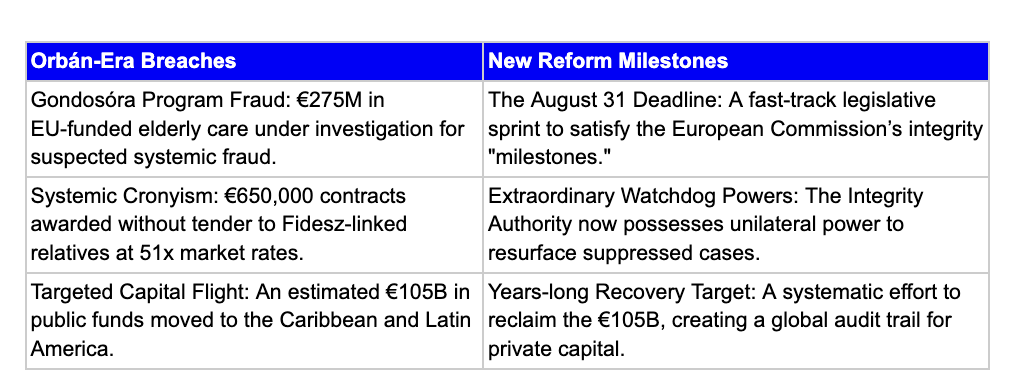
The €10.4 Billion Liquidity Trigger: Hungary faces an August 31 deadline to satisfy the European Commission’s transparency requirements. This release serves as a global stress test for EU anti-fraud mechanisms, establishing a more intrusive "Compliance Regime" that will inevitably be exported to African trade partners.
The "National Veto" Doctrine: The rise of Spain’s Vox, alongside nationalist factions in France and Italy, signals an era where national protectionism regarding migration and the "Green Deal" will routinely override Brussels-led trade agreements.
Fragmented Trade Diplomacy: African nations must prepare for a "Fortress Europe" mentality in the agricultural sector, even as industrial stalemates in Northern Europe open doors for energy and chemical alternatives.These institutional shifts necessitate a rigorous application of the "Science" filters to separate temporary political volatility from structural market realignments.
2. Regulatory & Compliance: The €10B Corruption Test and Institutional Reset
The "de-Orbánization" of Hungary provides a vital blueprint for African firms monitoring the next generation of EU regulatory standards. The Magyar government has institutionalized a clean break from the past; notably, the former Prime Minister’s office has been converted into the "Ministry of Social Affairs and Family," now a symbol of "European social cohesion." However, the irony for African observers is that the new liberal government is utilizing "extraordinarily extensive powers" for its Integrity Authority that exceed any other body in the EU, creating a high-pressure compliance landscape.Institutional Analysis: The Integrity Authority Framework The Integrity Authority is now aggressively purging historical "tolerated corruption" to unlock the €10.4 billion in post-pandemic recovery funds.
The Brussels Effect: De-Politicization as a Trade Barrier The "de-politicization" of Hungarian media, education, and civil society reflects a broader EU demand for "social dignity" standards. African entities with European exposure must recognize that compliance now extends beyond financial audits to include alignment with these social cohesion benchmarks. This shift toward more aggressive, intrusive monitoring will likely become the new standard for African firms seeking to maintain EU market access.
3. Supply Chain & Trade Corridors: Green Dilemmas and Agricultural Protectionism
As internal EU cleanup operations intensify, the physical movement of goods faces dual pressures from environmental litigation and systemic fraudulent reporting in the CAP (Common Agricultural Policy) framework.The Industrial Stalemate: A Window for African Downstream Entry The "Green Dilemma" is currently epitomized by the legal stalemate surrounding INEOS’s €5 billion Project One petrochemical factory in Antwerp.
European Supply Crunch: The persistent delay of this massive facility is creating a critical supply vacuum in the European chemicals sector.
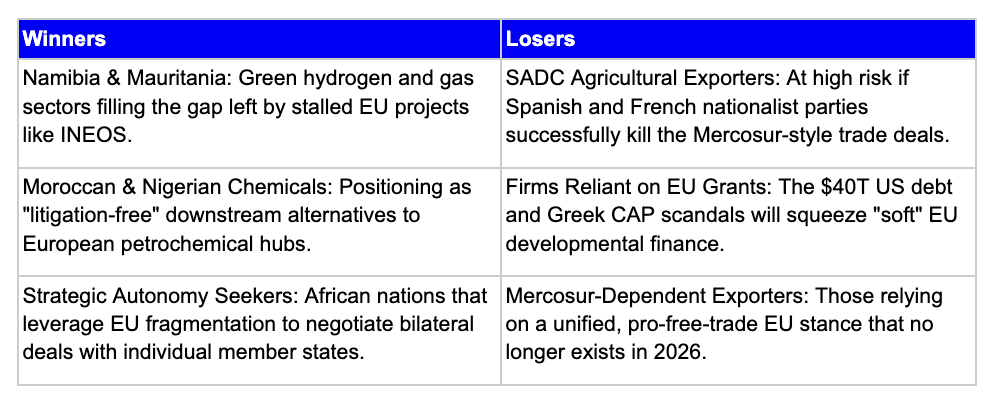
Strategic Opportunity: This litigation-driven bottleneck creates a vacancy that competitive African exporters—specifically those in Nigeria and Morocco who are developing downstream petrochemical capacities—can fill by positioning themselves as "litigation-free" and reliable supply chain alternatives.Agricultural Volatility and Protectionist Friction The discovery of "imaginary cows" in Greece—where farmers claimed subsidies for tens of thousands of non-existent animals—undermines the integrity of the EU’s €300B+ agricultural framework.
Friction Points: The Spanish Vox party’s aggressive stance against the Mercosur deal and EU fishing limits signals a move toward "intensive livestock" protectionism.
African Impact: Exporters in the SADC (Southern African Development Community) region must prepare for increased resistance to trade deals, as nationalist parties weaponize agricultural fraud to justify "Fortress Europe" policies.
4. Geopolitical Alignment: The Nationalist Surge and NATO’s Fragmentation
The rise of "National Veto" strategies among the European far-right (Vox in Spain, National Rally in France) is replacing the unified "Brussels voice" with a fragmented landscape of competing national interests.The Nationalist Wave: Strategic Implications
Vox (Spain): Poised to leverage a majority with the People’s Party to stall "automatically accommodating" Brussels initiatives, specifically regarding trade liberalization.
The French Nightmare: Marine Le Pen’s hostility toward NATO’s integrated command and Jean-Luc Mélenchon’s desire to exit the alliance entirely create a profound security vacuum in European defense policy. Maritime Risk and Trade Route Security The ongoing "Maritime Drone Wars" and the potential retreat of France from NATO command structures directly threaten global trade route security. If France—a primary contributor to maritime policing—scales back its involvement, African states must prepare for a vacuum in operations like the Gulf of Guinea patrols. The "So What?": African exporters should anticipate a sharp rise in maritime insurance premiums and must consider private-sector-led security frameworks to ensure route stability.
5. The "Power Play" Narrative: African Winners and Losers
Applying the "Mirror" technique, we interpret European institutional fragmentation as a catalyst for African strategic autonomy.The Energy and Capital Mirror
The Energy Opportunity: The Antwerp stalemate and the high borrowing costs driven by the $40 trillion US debt and the AI arms race create a vacuum in European industrial production. African energy leaders—specifically Namibia and Mauritania —are ideally positioned to fill this void with green hydrogen and gas as Europe seeks alternatives to its stalled internal green projects.
The Asset Recovery Angle: The tracking of the €105 billion in Hungarian capital flight into the Caribbean and Latin America suggests that African jurisdictions will soon face increased EU cooperation requests regarding anti-money laundering (AML) and asset recovery.